

- Home
- Fertility Law in BC
- confirming parentage for same sex couples
Confirming
Parentage for Same-Sex Couples After Birth
Your baby is here. You are overjoyed, exhausted, and completely in love. The last thing you want to think about is paperwork. But the steps you take in the days and weeks after birth matter more than many families realize. For same-sex couples in BC, confirming legal parentage is not always automatic, and gaps in legal status can have real consequences for your child later on.
This article walks you through how parentage is confirmed after birth in BC, what determines whether both parents are recognized automatically, and what to do if a gap exists.
Why parentage confirmation matters
Legal parentage is not just a label. It determines who can make medical decisions for your child, who can access school and healthcare records, how citizenship and residency status is passed on, and what inheritance rights your child has. It also governs what happens if the relationship between parents ends.
For same-sex couples, the law in BC has made enormous progress. But it is still possible to arrive at birth with one parent legally recognized and the other not, depending on how conception happened and what steps were or were not taken in advance.
Good to know
BC's Family Law Act was updated in 2013 and in subsequent years to be among the most inclusive parentage frameworks in Canada. However, the Act's automatic parentage rules still depend on how conception occurred and whether certain agreements were in place before birth.

How BC law determines parentage after birth
Under BC's Family Law Act, parentage is determined by a combination of biology, marriage or common-law status, and pre-birth agreements. Here is how the rules apply in the most common situations for same-sex couples.
Married or common-law same-sex couples using assisted reproduction
If you are married or in a common-law relationship and your child was conceived through assisted reproduction, BC law presumes both spouses are legal parents at birth, as long as both consented to the assisted reproduction. This means both parents should be able to be registered on the birth certificate without a court order, provided the circumstances are straightforward and documented.
Consent is the key word here. If there is any ambiguity about whether both partners agreed to the conception, the presumption can be challenged.
Unmarried same-sex couples
For unmarried same-sex couples, parentage is not automatically presumed for the non-birth or non-biological parent. If you did not have a pre-conception agreement in place, you may need to take additional steps after birth to confirm the second parent's legal status.
Important
Without confirmed legal parentage, a non-biological or non-birth parent may have no automatic right to make decisions for the child in a medical emergency. This gap can exist even in long-term, committed relationships. It is worth addressing as soon as possible.
Where a donor was involved
Whether you used a known donor or an anonymous sperm or egg donor affects how parentage is determined. In most cases involving a licensed fertility clinic and an anonymous donor, the donor has no parental rights or obligations. Known donor situations are more complex, especially if no written agreement was signed before conception.
If a known donor was involved and there was no pre-conception agreement, that donor may have parental standing under BC law, which could complicate your family's legal picture. This is one of the most common situations where families benefit from legal advice sooner rather than later.

Important
Changing your behaviour under an agreement or order without going through the proper process, even if you think the change is reasonable, can be used against you in court. If circumstances have changed and you want to vary what is in place, apply formally rather than acting unilaterally.
Registering both parents on the birth certificate
In BC, a child's birth must be registered with Vital Statistics within 30 days of birth. For same-sex couples who are married or in a qualifying common-law relationship and used assisted reproduction with consent, both parents can be registered at the time of registration.
To register, you will typically need to provide:
- Proof of marriage or common-law relationship (such as a marriage certificate or statutory declaration)
- Information about the assisted reproduction used
- Both parents' identification and personal information
If the situation is not straightforward, Vital Statistics may ask for additional documentation. In some cases, a court order confirming parentage is required before registration can be completed.
When
a court declaration of parentage is needed:
A court declaration of parentage is a legal order from the BC Supreme Court that formally confirms who a child's parents are. It becomes necessary in several situations that commonly arise for same-sex families.
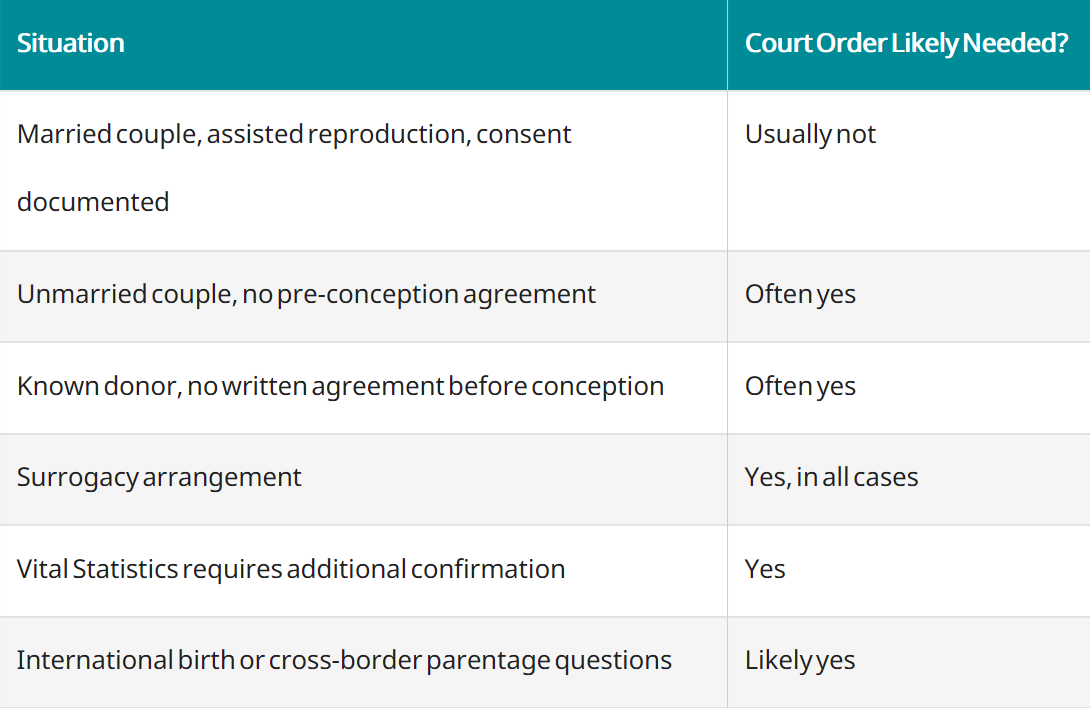
A parentage declaration from the BC Supreme Court is recognized across Canada and in many other countries. It is the strongest legal confirmation of your child's parentage and can prov ide important protection for your family's future.
What about adoption as a path to confirmation?
In some circumstances, particularly where a non-biological parent was not included in birth registration and a parentage declaration is complicated by the circumstances of conception, second-parent adoption may be an alternative path to legal recognition.
Second-parent adoption in BC allows a partner who is not a legal parent to adopt the child without the other parent losing their parental status. The result is that both adults are recognized as full legal parents. This route involves the BC Supreme Court and takes longer than a parentage declaration, but it creates an unambiguous legal record.
Steps to take if you are not sure where you stand
If you are not certain whether both parents are legally recognized, the most important thing you can do is get clarity quickly. Here is a practical starting point.
- Review your birth certificate. Review your birth certificate.
- If only one parent is listed, or if registration has not yet happened, that is your first signal to get advice.
- Gather your conception documents. This includes any fertility clinic agreements, donor agreements, or pre-conception contracts you signed.
- Check your relationship status on record. Marriage certificates and common-law declarations may be relevant to how Vital Statistics or a court assesses your situation.
- Speak with a family law lawyer. A lawyer familiar with BC's parentage rules can assess your specific situation and tell you exactly what steps are needed, whether that is a registration update, a court declaration, or a second-parent adoption.
How Pathway Legal can help
Parentage matters. Not just for your peace of mind today, but for your child's future: their rights, their identity, and their legal connection to both of the people who love them.
At Pathway Legal, we work with LGBTQ+ families across BC to confirm parentage, navigate Vital Statistics, and when needed, bring parentage declarations before the BC Supreme Court. We serve clients in Victoria, Nanaimo, Vancouver, and Surrey, and we meet with families province-wide by video.
We offer a money-back guarantee on the initial consultation fee. If you come in and it is not the right fit, you do not pay. Our goal is to give you a clear picture of where you stand and exactly what it will take to protect your family's legal foundation.
This article is for general informational purposes only and does not constitute legal advice. Family law is fact-specific and the law changes. Reading this does not create a lawyer-client relationship with Pathway Legal. For advice about your situation, consult a qualified BC family law lawyer.

Content written by:
Val Hemminger, divorce lawyer with heart, founder of Pathway Legal, terrier lover, Mom, fun person, and because every great legal team needs at least one ADHD powered person
Not Sure Where You Stand? Talk to One of Our Lawyers
Something has shifted, and you are not sure what it means yet. That is exactly the right time to get clarity, not after you have waited too long and deadlines have passed.
Schedule a consultation with Pathway Legal.
Our initial consultation is real legal guidance, not a sales pitch. And we stand behind it: if you do not feel you received genuine value, we will refund your initial consultation fee. No questions asked.*
In the years we have done this, almost no one has asked for their money back.
*Unlike most law firms, our initial consultation is not free. Your time with one of our lawyers is real legal guidance, not a sales pitch. A one-hour conversation that helps you understand your rights, your timelines, and your options is one of the smallest investments you can make when the stakes are high.






FAX: 833-250-7771
Meeting Locations
Money-back guarantee for your initial consultation
We are SO confident you’ll be impressed with your lawyer and the support you receive at your first appointment, we’ll refund the initial consultation fee if you’re not completely satisfied.
Meeting Locations
Money-back guarantee for your initial consultation
We are SO confident you’ll be impressed with your lawyer and the support you receive at your first appointment, we’ll refund the initial consultation fee if you’re not completely satisfied.
Pathway Legal Law Corporation, Family Law Lawyers. All rights reserved Val Hemminger
Your Privacy Sitemap Contact Us Legal Disclaimer SMS T&C's
Copyright © [2020] –
It is with our honour and gratitude that we live, work, and play on the traditional territory of the Coast Salish peoples–Sḵwx̱wú7mesh (Squamish), Stó:lō and Səl̓ílwətaʔ/Selilwitulh (Tsleil-Waututh) and xʷməθkʷəy̓əm (Musqueam) Nations.