

- Home
- Property and Money
Who Gets What? Property and Money in a BC Divorce

Money decisions made during a separation follow you for years. The house, the pension, the debt, the business, the RRSPs, and even the dog! All of it gets sorted during a window of time when most people are exhausted and not thinking at their sharpest.
This is the stage where people give away things they were entitled to keep, and take on debt that was never theirs to carry. Usually because nobody explained the rules to them before they signed.
British Columbia has a clear framework for dividing property and debt. It surprises most people the first time they hear it. This page walks you through that framework in plain language, shows you where the expensive mistakes happen, and points you to the deeper articles underneath it.
The starting point: equal division, and whose name is on it does not matter
Under the BC Family Law Act, property either of you acquires during the relationship is family property, and the presumption is that it gets divided equally when the relationship ends.
Title does not change that presumption. A house registered in one name, a savings account in one name, a vehicle in one name: in most cases, are still family property, and that means they are still shared.
The reverse is equally true. Something in your name is not automatically yours to keep, and something in your spouse’s name is not out of your reach. What matters is when it was acquired and where the money came from, not what the paperwork says on the front.
Equal division is a starting presumption, not a guarantee, and there are real exceptions below.
What counts as family property
Family property is broader than most people expect. It generally includes:
- The family home, regardless of who is on title or who paid the down payment.
- Bank and investment accounts: savings accounts, chequing accounts, TFSAs, non-registered investments and cash held at the date of separation.
- RRSPs, RRIFs and pensions: the portion earned or contributed during the relationship.
- Business interests: shares in a company, partnership interests, and certain beneficial interests in a trust.
- Tangible property: vehicles, boats, trailers, recreational property, valuable collections and equipment.
- Policies and entitlements: life insurance with cash surrender value, employment stock options and vested benefits.
- The increase in value of excluded property during the relationship, even when the underlying asset itself is excluded. This one catches people off guard, and we explain it next.
Excluded property, and how people quietly lose it
Some property stays out of the pot. Excluded property usually covers what you brought into the relationship, inheritances, gifts to you from someone outside the relationship, the pain and suffering part of your ICBC case, and certain trust interests and insurance proceeds.
Here is the part that surprises people. The exclusion protects the value the asset had when you brought it in or received it. Any growth in value during the relationship is family property and is shared. An inherited property worth $300,000 at the date of the gift and $500,000 at separation typically shelters the $300,000 and shares the $200,000 of growth.
The spouse claiming an exclusion carries the burden of proving it. That proof is documentary: statements, transfer records, wills, gift letters, a clear paper trail from the source to the asset you hold today.
Where exclusions get lost
Mingling is the single most common way an exclusion disappears. An inheritance deposited into a joint account, or used as a down payment on a home held in both names that is then refinanced. What you want to ensure is that your excluded property is traceable.
Courts have found exclusions defeated when the paper trail ran out, even where both spouses agreed the money originally came from one side. If you are sitting on an inheritance, pre-relationship savings or a gift, gather the records now rather than later.
Family debt gets divided too, and this is where people get hurt
Debt taken on during the relationship is presumptively shared, in the same way property is. Credit cards, lines of credit, vehicle loans, tax debt owed to the Canada Revenue Agency, and money borrowed from family all come into the analysis.
Debt incurred after separation can still be family debt when it was used to maintain family property, for example, paying the mortgage, property taxes or necessary repairs on the family home while it sits unsold.
Splitting debt in an agreement does not release you from it with the lender. If your name is on a joint credit line, the bank can still pursue you for the full balance no matter what your separation agreement says. The fix is refinancing, closing the account, or building protections into the agreement itself.
Three debt traps we see repeatedly
Leaving your name on a joint mortgage after transferring your interest in the home. You keep the liability and lose the asset.
Unfiled or unpaid tax debt from years when a business was involved. It does not go away, and it is often family debt.
Continuing to pay a joint credit card after separation without documenting it, then having no record of the contribution when the final accounting is done.
The family home
BC does not give the family home special legal status the way some provinces do. It is family property, and it is divided like family property. What makes it complicated is that it is often the largest asset, the family’s living arrangement, and an emotional anchor all at the same time.
There are generally four practical outcomes: sell and divide the net proceeds, one of you buys the other out, the sale is deferred to a defined future date, or the home is transferred as part of a larger trade against other assets.
A buyout depends on two things people often skip: a current appraisal both of you accept, and confirmation that the buying spouse can actually qualify for the mortgage alone. Agreeing to a buyout that financing will not support can cost months of delay.
If living together has become unworkable, exclusive occupancy of the home can be addressed by agreement or by court order. That is a separate question from who ultimately owns it.
Pensions, RRSPs and CPP credits
A defined benefit pension is frequently the largest asset in a long relationship, and it is also the one often overlooked. Pension entitlement earned during the relationship is divisible under the Family Law Act, through forms filed with the plan administrator rather than a simple cash transfer.
RRSPs can be transferred between spouses on a tax-deferred basis when there is a written separation agreement or court order and the correct CRA form is used. Move that money without the proper paperwork, and you can trigger tax and lose contribution room permanently.
Canada Pension Plan credits are their own process. Credit splitting is handled federally through Service Canada and does not happen automatically because you divided everything else. It is regularly missed, and it can matter a great deal to the lower-earning spouse in retirement.
Pension valuation is technical. Two pensions with the same annual payout can have very different present values depending on indexing, survivor benefits and the member’s age.
When one of you owns a business

Shares in a private company are family property. The dispute is almost never about whether they are divisible, it is about what they are worth.
Valuation questions drive the cost of these matters: fair market value compared to value to the owner, whether a minority interest attracts a discount, how redundant assets inside the company are treated, and whether the owner’s compensation needs to be normalized to reflect what an arm’s length manager would earn.
A jointly retained business valuator often costs a fraction of two opposing experts, and produces a number both sides can build an agreement around. Where trust has broken down entirely, separate experts may be necessary.
Business ownership also affects support. Income for support purposes is not always the figure on a T1 return, and corporate pre-tax income can be attributed to a shareholder spouse in the right circumstances. Property and support get analyzed together when a company is in the picture.
When equal is not fair: the significant unfairness test
The Family Law Act allows a court to divide family property or debt unequally, but the threshold is deliberately high. It is not enough that an equal division feels unfair or disappointing. It has to be significantly unfair.
Courts look at factors including the length of the relationship, contributions one spouse made to the other’s excluded property, whether family debt is unusually large relative to family property, and whether one spouse’s conduct substantially reduced the value of family property.
There is a separate and even narrower route for dividing excluded property itself, which generally requires a longer relationship, a real contribution by the other spouse to that property, or practical impossibility of dividing property located outside BC.
Most unequal division arguments do not succeed. Understanding that early saves people from spending many months, and sometimes years, chasing an outcome the legislation rarely delivers.
Financial disclosure is the engine of the entire process
Both spouses have a legal duty to provide full and true financial disclosure. Nothing meaningful can be negotiated until each of you can see the whole picture, and an agreement built on incomplete disclosure can be set aside later.
The core package usually includes:
- Three years of tax returns and Notices of Assessment.
- Recent pay stubs or proof of current income from all sources.
- Statements for every bank, investment, RRSP, TFSA and credit account at the date of separation.
- Mortgage statements, property tax assessments and any appraisals.
- Pension statements showing the commuted value or accrued entitlement.
- Corporate financial statements and tax returns where a business is involved.
- Documents supporting any excluded property claim.
Withholding information is expensive. It invites applications to compel disclosure, costs awards, and the risk of a completed agreement being reopened years later. Producing documents is cheaper than fighting about producing documents.
Married or common-law: what changes, and what does not
In BC, two people who have lived together in a marriage-like relationship for at least two years are spouses for property purposes. They have essentially the same property and debt division rights as married couples. That is different from most of Canada and it surprises people constantly.
Couples together less than two years who have a child together are spouses for support purposes, but not for property division. Anyone in that position needs advice specific to their situation, because the claims available are different ones.
There is no such thing as legal separation status in BC. You are separated when one of you decides the relationship is over, communicates that, and acts on it. That date matters enormously, which is why we recommend documenting it in writing at the time.
The two-year clock most people never hear about
Married spouses generally have two years from the date a divorce is granted, to start a claim for division of property, debt, pension or spousal support.
Common-law (aka unmarried) spouses generally have two years from the date of separation. That clock runs whether or not anyone has started the legal paperwork, and missing it can end a property claim permanently.
The limitation period can be suspended while spouses are engaged in family dispute resolution with a qualified professional such as a mediator. Relying on that without advice is risky. If you separated more than a year ago and nothing is in writing, this is the reason to speak with a lawyer now rather than after the holidays. If in doubt, file early.
Who gets the dog

Since January 2024, BC law treats companion animals as their own category within property division. A court deciding ownership must weigh factors including how the animal was acquired, who cared for it, any history or risk of family violence, cruelty or threatened cruelty toward the animal, the relationship between the animal and any children, and each person’s willingness and ability to meet the animal’s basic needs.
There is a catch worth knowing before anyone spends money fighting about it. A court cannot order joint ownership of a companion animal, and cannot order either of you to share possession.
You can, however, agree to a sharing arrangement between yourselves and write it into your separation agreement. If your dog matters to both of you, that is a strong argument for resolving it at a table rather than in a courtroom. Guide dogs, service dogs, working animals and agricultural animals are treated differently under these rules. They are not considered companion animals.
The tax side nobody warns you about
Two assets with identical values on a spreadsheet can be worth very different amounts after tax. Dividing property without running the tax consequences is one of the most common ways a settlement that looked equal turns out not to be.
- Principal residence exemption: Only one property can be designated a principal residence for a given year, which matters when a couple owns a home plus a cabin or rental.
- Registered accounts and recreational or investment property carry embedded capital gains. A $200,000 RRSP is not equivalent to $200,000 of home equity.
- Support treatment: periodic spousal support is generally deductible to the payor and taxable to the recipient, while child support is neither. Lump sums are treated differently again.
- Timing: transfers between spouses can often be structured on a tax-deferred basis when the agreement and forms are done correctly, and cannot be fixed afterward.
We work alongside accountants regularly, and we would rather flag a tax issue before you sign than watch a client absorb it the following April.
What this costs, and what drives the number
Cost in a property matter is driven almost entirely by how the two of you engage with each other, not by how many assets you own. These are the ranges we see:
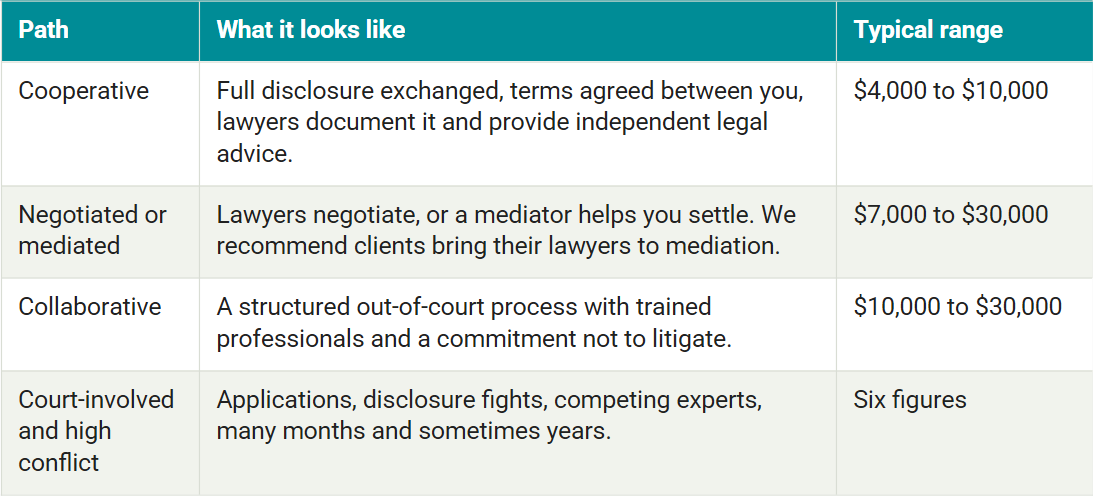
The things that push a matter up a tier are predictable: incomplete disclosure, competing valuations of the same asset, and one party treating the process as a contest. The things that keep it down are equally predictable, starting with getting advice before positions harden.
How we approach property and money at Pathway Legal
We are resolution-first. Every property and money conversation starts with the same goal, which is helping you reach a final separation agreement that is fair, legally sound, and lets you move forward with your life.
That is not softness. Getting a good outcome outside court requires thorough disclosure, accurate valuations, and a lawyer willing to tell you when an offer is not good enough. It also requires knowing when court genuinely is the right tool, and we will tell you that too.
What we don’t want to do is run up a fight that leaves both of you poorer than the disagreement was worth.
Where to go next
Each of these goes deeper on a piece of what you have read here.
- Division of property in divorce in BC: the full framework, how equal division works in practice, and the myths worth discarding early. Start here if you are new to all of this.
- Separation Agreements: what goes into a separation agreement, how it gets made binding, and what makes one hold up.
- Common-law Agreements: property and debt rights for couples who never married, and the deadline that catches them out.
- High net worth divorce lawyers in BC: the nine qualities to look for when the financial picture includes corporations, portfolios or multiple properties.
- Medium to high net worth divorce: what changes when there is a business, real estate beyond the family home, or complex compensation in the mix.
- Support: Child support and spousal support sit alongside property division and affect each other.
If you are still at the beginning and not sure what applies to you, our Getting Started and Divorce 101 sections cover the ground before this one.

Journey here. Real questions about property and money, with straight answers and no legal jargon. Open the one on your mind.
I have no idea what we even own. Where do I start?
Start with a list, not a lawyer's office. Write down every account, property, debt, pension and policy either of you holds, and the approximate value at the date you separated. Our page on division of property in BC walks through the full framework once you have that picture.
My spouse says the house is theirs because it is in their name. Are they right?
Usually not. Title is not the test in BC. If the home was acquired during your relationship, it is generally family property regardless of whose name appears on it.
What if I think my spouse is hiding money?
Say so early. There are established tools for this, from formal disclosure demands through to third party document requests. Bring a lawyer the pattern you have noticed and why you are thinking what you are thinking.
Do we both have to hand everything over even if we are being friendly about it?
Yes. The duty applies no matter how cooperative you are, and a friendly agreement built on partial information is the kind that unravels later.
Can we share the dog after we separate?
Only by agreement. A judge cannot order shared possession, so a written arrangement between the two of you is the only route to a schedule that holds.
This article is for general informational purposes only and does not constitute legal advice. Family law is fact-specific and the law changes. Reading this does not create a lawyer-client relationship with Pathway Legal. For advice about your situation, consult a qualified BC family law lawyer.

Content written by:
Val Hemminger, divorce lawyer with heart, founder of Pathway Legal, terrier lover, Mom, fun person, and because every great legal team needs at least one ADHD powered person
Not Sure Where You Stand? Talk to One of Our Lawyers
Something has shifted, and you are not sure what it means yet. That is exactly the right time to get clarity, not after you have waited too long and deadlines have passed.
Schedule a consultation with Pathway Legal.
Our initial consultation is real legal guidance, not a sales pitch. And we stand behind it: if you do not feel you received genuine value, we will refund your initial consultation fee. No questions asked.*
In the years we have done this, almost no one has asked for their money back.
*Unlike most law firms, our initial consultation is not free. Your time with one of our lawyers is real legal guidance, not a sales pitch. A one-hour conversation that helps you understand your rights, your timelines, and your options is one of the smallest investments you can make when the stakes are high.








FAX: 833-250-7771
Meeting Locations
Money-back guarantee for your initial consultation
We are SO confident you’ll be impressed with your lawyer and the support you receive at your first appointment, we’ll refund the initial consultation fee if you’re not completely satisfied.
Meeting Locations
Money-back guarantee for your initial consultation
We are SO confident you’ll be impressed with your lawyer and the support you receive at your first appointment, we’ll refund the initial consultation fee if you’re not completely satisfied.
Pathway Legal Law Corporation, Family Law Lawyers. All rights reserved Val Hemminger
Your Privacy Sitemap Contact Us Legal Disclaimer SMS T&C's
Copyright © [2020] –
It is with our honour and gratitude that we live, work, and play on the traditional territory of the Coast Salish peoples–Sḵwx̱wú7mesh (Squamish), Stó:lō and Səl̓ílwətaʔ/Selilwitulh (Tsleil-Waututh) and xʷməθkʷəy̓əm (Musqueam) Nations.