

- Home
- Fertility Law in BC
- known donor vs anonymous donor know the difference
Known
donor vs. anonymous donor: know the legal differences
Choosing a donor is one of the most personal decisions in family formation. It is also one with legal consequences that most families do not fully understand until something goes wrong.
In BC, whether your donor is someone you know or someone whose profile you chose from a clinic catalogue changes your legal picture significantly. This article explains what the law actually says, what can happen without the right agreement in place, and what both paths require to protect your family.
What BC law says about donors
Under BC's Family Law Act, donating sperm, an egg, or an embryo does not automatically make someone a legal parent. Section 24 of the Act is clear: a donor of genetic material is not a parent of a child conceived using that material, provided the conception occurred through assisted reproduction.
That protection applies whether the donor is anonymous or known. But it comes with conditions. And for known donors, the risk of those conditions not being met is much higher.

Good to know
BC's rules only apply when conception occurs through assisted reproduction, meaning a method other than sexual intercourse. If a known donor and an intended parent conceive through sexual intercourse, the donor is not treated as a donor under the law. They become a legal parent, with full parental rights and obligations, regardless of any informal agreement.
Using an anonymous donor through a licensed clinic
When you use an anonymous sperm or egg donor through a licensed fertility clinic, the legal picture is generally clean. The clinic screens donors, manages consent, and handles the medical process under protocols that satisfy the federal Assisted Human Reproduction Act. The donor has no legal parental status, and in most cases no additional agreement is required to establish that.
Your parentage as the intended parent or parents is established through BC's birth registration process. If you are married or in a common-law relationship and both consented to the assisted reproduction, both of you can be registered as parents without a court order.
Anonymous donation does carry one practical reality that families should understand: anonymity is increasingly difficult to maintain. Genetic testing services like 23andMe and AncestryDNA mean that a donor-conceived child who wants to find their genetic origins likely can, regardless of what the clinic's records say. This is not a legal issue in BC right now, but it is worth thinking about as you make your decision.
Using a known donor: more personal, more legally complex
A known donor is someone you have chosen personally: a friend, a family member, an acquaintance. There are real reasons families go this route. You may want your child to know their genetic heritage. You may value the transparency and relationship that comes with knowing the person. You may want to avoid clinic donor fees.
All of those are valid reasons. And none of them change the fact that known donor arrangements require careful legal preparation that anonymous donor arrangements do not.
Important
Without a written pre-conception donor agreement, a known donor in BC may have legal standing as a parent. That means potential rights to parenting time, and potential obligations including child support. An informal understanding between friends is not enough.
What a known donor agreement must cover
A proper known donor agreement is a written, pre-conception document that sets out the intentions of all parties before the child is conceived. Both the intended parent or parents and the donor should have independent legal advice before signing.
A complete agreement addresses:
- Parental status: the donor is not a parent, and will not seek parental rights or responsibilities
- Parenting time and contact: whether the donor will have any ongoing relationship with the child, and on what terms
- Financial obligations: confirming the donor has no child support obligations
- Expense reimbursement: what costs, if any, the intended parents will cover, and how those will be documented
- Method of conception: confirming assisted reproduction will be used, not sexual intercourse
- Future contact by the child: what happens if the child seeks out the donor as an adult
- What happens if the relationship between the parties changes: breakups, deaths, and disagreements do not stay neatly in the future
The agreement cannot override BC law entirely. A court will not enforce a term that is contrary to a child's best interests. But a well-drafted agreement creates a strong record of everyone's intentions, and courts in BC have shown a willingness to honour those intentions when disputes arise.
Known
donor vs. anonymous donor: a quick comparison
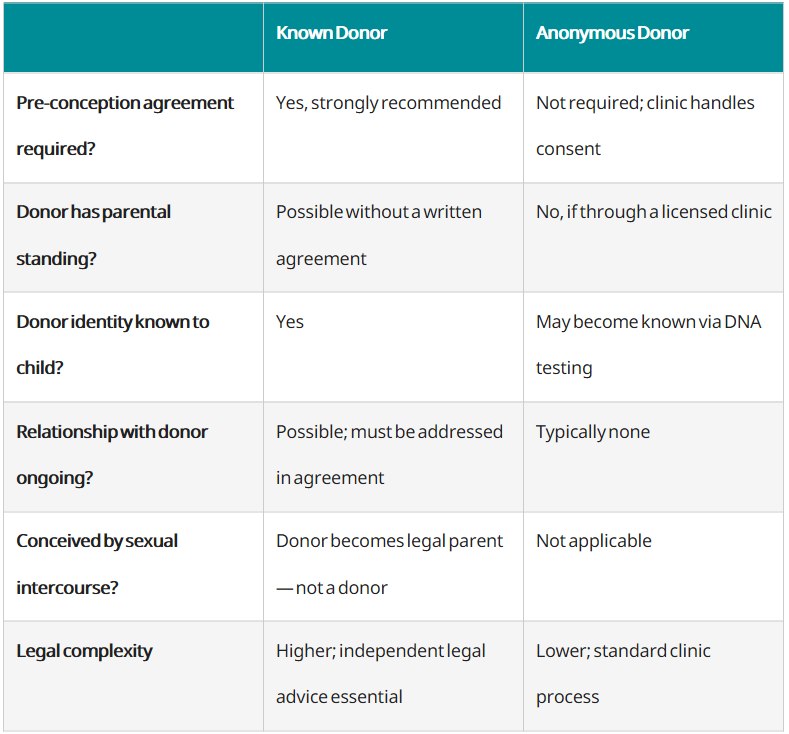
The rule that surprises most families
BC's Family Law Act only governs donor situations that involve assisted reproduction. If a child is conceived through sexual intercourse with a known donor, the donor is not treated as a donor at all. They are treated as a biological parent, and no prior agreement changes that.
This means that if a known donor and an intended parent have sex and a pregnancy results, the donor has the same legal standing as any biological parent. They can seek parenting time. They may have child support obligations. And the intended parent's partner, if there is one, does not automatically become a parent.
This rule is one of the most important reasons that known donor arrangements must go through a licensed fertility clinic or regulated medical process. An agreement saying conception will happen by assisted reproduction only, combined with actually following through on that, is essential.
The informal version of a known donor arrangement, where a friend donates and conception happens at home, is not legally protected in BC. It can result in a family structure no one planned for.
What if no agreement was signed before conception?
If you already have a child conceived with a known donor and no agreement was in place, that does not mean your situation is beyond fixing. It does mean it is more complicated.
A court can make a declaration of parentage under the Family Law Act. The court will look at the circumstances of the conception, the conduct of all parties, and the best interests of the child. Depending on the facts, that process may confirm your intended family structure or it may not.
The earlier you get legal advice, the more options you have. Waiting until there is a dispute limits them significantly.
How Pathway Legal can help
Whether you are still deciding between a known and anonymous donor, or you are already in a situation that needs sorting out, getting legal advice early makes a real difference.
At Pathway Legal, we help families across BC navigate donor agreements, parentage registration, and court declarations when needed. We serve clients from our offices in Victoria, Nanaimo, Vancouver, and Surrey, and by video for families anywhere in the province.
We offer a money-back guarantee on the initial consultation fee. Come in, tell us your situation, and we will give you a clear picture of where you stand and what it will take to protect your family. If it is not the right fit, you do not pay.
This article is for general informational purposes only and does not constitute legal advice. Family law is fact-specific and the law changes. Reading this does not create a lawyer-client relationship with Pathway Legal. For advice about your situation, consult a qualified BC family law lawyer.

Content written by:
Val Hemminger, divorce lawyer with heart, founder of Pathway Legal, terrier lover, Mom, fun person, and because every great legal team needs at least one ADHD powered person
Not Sure Where You Stand? Talk to One of Our Lawyers
Something has shifted, and you are not sure what it means yet. That is exactly the right time to get clarity, not after you have waited too long and deadlines have passed.
Schedule a consultation with Pathway Legal.
Our initial consultation is real legal guidance, not a sales pitch. And we stand behind it: if you do not feel you received genuine value, we will refund your initial consultation fee. No questions asked.*
In the years we have done this, almost no one has asked for their money back.
*Unlike most law firms, our initial consultation is not free. Your time with one of our lawyers is real legal guidance, not a sales pitch. A one-hour conversation that helps you understand your rights, your timelines, and your options is one of the smallest investments you can make when the stakes are high.






FAX: 833-250-7771
Meeting Locations
Money-back guarantee for your initial consultation
We are SO confident you’ll be impressed with your lawyer and the support you receive at your first appointment, we’ll refund the initial consultation fee if you’re not completely satisfied.
Meeting Locations
Money-back guarantee for your initial consultation
We are SO confident you’ll be impressed with your lawyer and the support you receive at your first appointment, we’ll refund the initial consultation fee if you’re not completely satisfied.
Pathway Legal Law Corporation, Family Law Lawyers. All rights reserved Val Hemminger
Your Privacy Sitemap Contact Us Legal Disclaimer SMS T&C's
Copyright © [2020] –
It is with our honour and gratitude that we live, work, and play on the traditional territory of the Coast Salish peoples–Sḵwx̱wú7mesh (Squamish), Stó:lō and Səl̓ílwətaʔ/Selilwitulh (Tsleil-Waututh) and xʷməθkʷəy̓əm (Musqueam) Nations.