

- Home
- Fertility Law in BC
- When Co-Parenting Agreements Become Parenting Orders
When
co-parenting agreements become parenting orders
A co-parenting agreement works well when both parents honour it. When one of them stops, a piece of paper that was never filed in court does not have much force behind it.
This article explains the difference between a co-parenting agreement and a parenting order in BC, when families need to go to court instead of relying on an agreement, how to convert an existing agreement into a consent order, and what happens when things go sideways and enforcement becomes necessary.
Agreement vs. order: what is the difference?

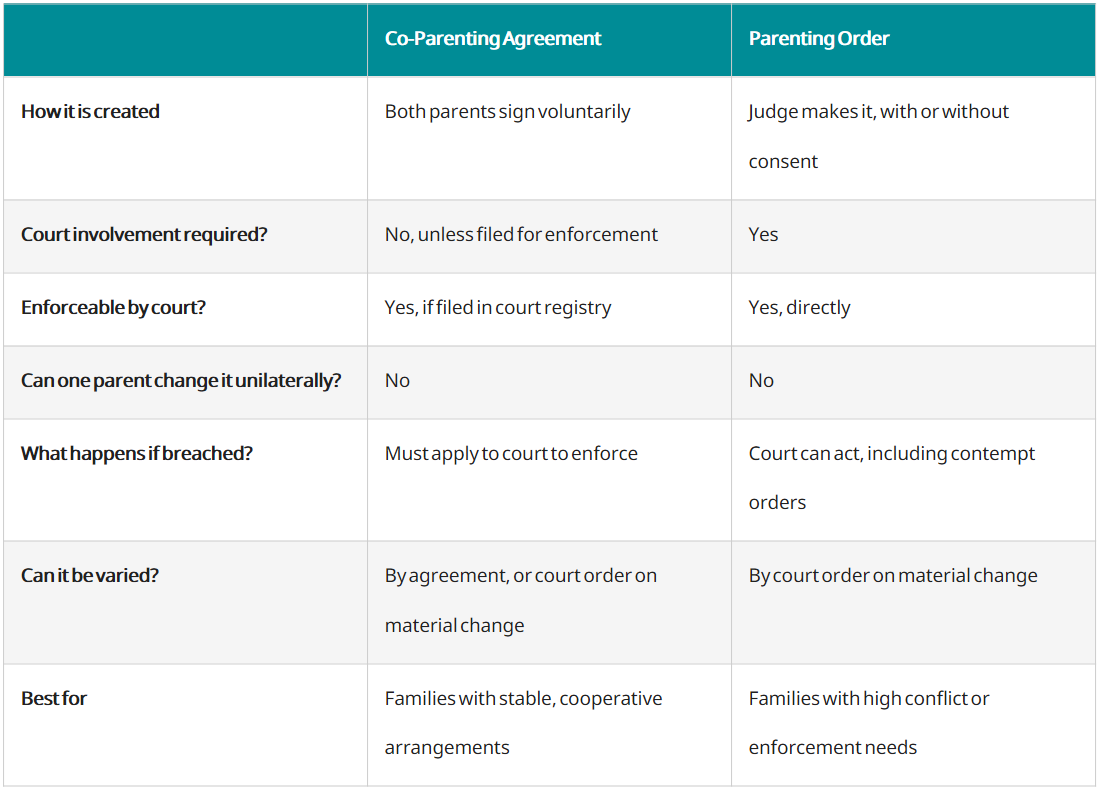
A co-parenting agreement is a contract. Both parents sign it voluntarily, and it sets out their mutual intentions about parenting time, responsibilities, and decision-making. It does not require court involvement to create. But if one parent ignores it, the other parent has to go to court to enforce it.
A parenting order is made by a judge. It carries the full weight of a court order from the moment it is made. If one parent breaches it, the other can return to court for enforcement, and the consequences for the breaching parent are more immediate and more serious.
BC's Family Law Act allows co-parenting agreements to be filed in the court registry. Once filed, a court can treat and enforce the agreement the same way it would a court order. That single step dramatically changes what happens when someone does not follow through.
When a parenting order is the better starting point
For many co-parenting families, a well-drafted agreement that is filed in the court registry is sufficient. For others, going straight to a parenting order from the beginning makes more sense. A parenting order is typically the better choice when:
- There is high conflict between the co-parents. When communication has already broken down or trust is low before the child is born or shortly after, an agreement that relies on mutual goodwill is fragile. A court order gives both parents a firmer foundation.
- One parent has a history of not following through. If there is already a pattern of one parent unilaterally changing arrangements or failing to comply, an agreement is unlikely to hold. A court order with enforcement mechanisms is the appropriate tool.
- There are safety concerns. If family violence, substance use, or other safety issues are present, a parenting order allows the court to impose specific conditions on parenting time, including supervision requirements, that an agreement between the parties cannot enforce the same way.
- The arrangement is complex or unusual. Three-parent arrangements, significant relocation concerns, or situations where one co-parent has never lived with the child may benefit from the clarity and legal weight of a court order from the outset.
- One
parent is uncooperative about signing an agreement. A
court can make a parenting order even if one parent refuses to
negotiate or sign. An agreement requires both parties. An order does
not.
How to convert a co-parenting agreement into a consent order
If you already have a co-parenting agreement and both parents want to give it the force of a court order, BC law provides a relatively straightforward way to do that: a consent order.
A consent order is a parenting order that both parents agree to. Because it is by consent, the parties do not need to appear before a judge in a contested hearing. They submit their agreement to the court, along with the required documentation, and a judge reviews it to confirm it is in the best interests of the child. If it is, the consent order is made.
The practical steps are:
- Prepare the consent order document in the required court form (Form 17 in Provincial Court, or the equivalent in BC Supreme Court)
- Both parents sign the consent order
- File the application at the appropriate court registry with the required supporting documents
- A judge reviews the application without the parties attending court
- If approved, the consent order is issued and has the same legal force as any other parenting order
Good to know
You can apply for a consent parenting order in either the BC Provincial Court or the BC Supreme Court. Provincial Court is generally faster and less expensive. Supreme Court orders may carry more weight in some circumstances, including in international situations. A family lawyer can help you choose the right court for your family.
When circumstances change: varying an agreement or order
A co-parenting arrangement that worked well when the child was an infant may not work well when they are seven. Parenting agreements and orders can be changed, but the process depends on whether you have an agreement or an order, and whether both parents agree to the change.
Varying an agreement
If both parents agree to change the terms of their co-parenting agreement, they can simply sign a new agreement or an amendment to the existing one. No court involvement is needed unless they also want the revised terms to have the force of a court order.
If one parent wants to change the agreement and the other does not, the parent seeking the change must apply to court. The court will only vary a parenting arrangement if there has been a material change in circumstances since the agreement was made. A material change is a significant shift in the circumstances of the child or one of the parents that was not anticipated when the arrangement was originally set.
Varying a parenting order
The same material change test applies to varying a parenting order. The parent applying for the variation must satisfy the court that something significant has changed, and that the proposed new arrangement is in the best interests of the child.
What counts as a material change is not always obvious, but common examples include:
- A parent relocating to another city or province
- A significant change in a parent's work schedule or availability
- A change in the child's needs, health, or school situation
- A change in the child's relationship with a parent or new household member
- One parent consistently failing to follow the existing arrangement
Important
Changing your behaviour under an agreement or order without going through the proper process, even if you think the change is reasonable, can be used against you in court. If circumstances have changed and you want to vary what is in place, apply formally rather than acting unilaterally.
When the other parent does not follow the agreement or order
Parenting time is denied. The schedule is ignored. A major decision gets made without consultation. These situations are unfortunately common, and how you respond depends on what you have in place.
If you have an agreement that has been filed in court
A filed co-parenting agreement can be enforced by the court. You can apply for an order to enforce your parenting time or parental responsibilities. Under section 61 of the Family Law Act, the court has a range of tools available, including:
- Ordering make-up parenting time to replace what was denied
- Requiring the breaching parent to reimburse costs caused by the breach, including travel, childcare, or lost wages
- Requiring either or both parents to attend family dispute resolution or counselling
- In serious or repeated cases, varying the parenting arrangement to better reflect what is actually working
If you have a parenting order
A parenting order carries additional enforcement weight. Repeated or serious non-compliance can lead to a finding of contempt of court, which can result in fines or, in extreme cases, imprisonment. The bar for contempt is high, but its availability changes the dynamic in high-conflict situations.
Good to know
Document everything. Dates, times, what was supposed to happen, and what actually happened. If you ever need to apply for enforcement or a variation, that record is the foundation of your case. Start keeping it before you think you will need it.
What to do now
Whether you are setting up a co-parenting arrangement for the first time, reviewing an existing agreement, or dealing with a breakdown, the steps below apply.
- File your agreement. If you have a written co-parenting agreement, file it in the court registry. It costs very little and significantly improves your position if enforcement ever becomes necessary.
- Consider a consent order. If both parents are willing, converting your agreement to a consent order gives it the full force of a court order from day one.
- Document the arrangement in practice. Keep a record of parenting time, decisions made, and any departures from what the agreement says. This is your evidence if things change.
- Get legal advice before you vary anything. If circumstances have changed and you want to update your arrangement, talk to a lawyer before you start acting on the new plan. Going through the right process protects you.
- Do not wait until there is a crisis. The families who need court involvement most urgently are often the ones who waited the longest to formalize their arrangement. Early legal advice is almost always cheaper and less stressful than late legal intervention.
How Pathway Legal can help
Co-parenting arrangements work best when everyone has clear expectations and real legal backing. Whether you need to draft a new agreement, convert an existing one to a consent order, apply to vary your current arrangement, or enforce your parenting time, Pathway Legal can help.
We work with co-parents across BC from our offices in Victoria, Nanaimo, Vancouver, and Surrey, and by video for families anywhere in the province. We offer a money-back guarantee on the initial consultation fee. If it is not the right fit, you do not pay.
This article is for general informational purposes only and does not constitute legal advice. Family law is fact-specific and the law changes. Reading this does not create a lawyer-client relationship with Pathway Legal. For advice about your situation, consult a qualified BC family law lawyer.

Content written by:
Val Hemminger, divorce lawyer with heart, founder of Pathway Legal, terrier lover, Mom, fun person, and because every great legal team needs at least one ADHD powered person
Not Sure Where You Stand? Talk to One of Our Lawyers
Something has shifted, and you are not sure what it means yet. That is exactly the right time to get clarity, not after you have waited too long and deadlines have passed.
Schedule a consultation with Pathway Legal.
Our initial consultation is real legal guidance, not a sales pitch. And we stand behind it: if you do not feel you received genuine value, we will refund your initial consultation fee. No questions asked.*
In the years we have done this, almost no one has asked for their money back.
*Unlike most law firms, our initial consultation is not free. Your time with one of our lawyers is real legal guidance, not a sales pitch. A one-hour conversation that helps you understand your rights, your timelines, and your options is one of the smallest investments you can make when the stakes are high.








FAX: 833-250-7771
Meeting Locations
Money-back guarantee for your initial consultation
We are SO confident you’ll be impressed with your lawyer and the support you receive at your first appointment, we’ll refund the initial consultation fee if you’re not completely satisfied.
Meeting Locations
Money-back guarantee for your initial consultation
We are SO confident you’ll be impressed with your lawyer and the support you receive at your first appointment, we’ll refund the initial consultation fee if you’re not completely satisfied.
Pathway Legal Law Corporation, Family Law Lawyers. All rights reserved Val Hemminger
Your Privacy Sitemap Contact Us Legal Disclaimer SMS T&C's
Copyright © [2020] –
It is with our honour and gratitude that we live, work, and play on the traditional territory of the Coast Salish peoples–Sḵwx̱wú7mesh (Squamish), Stó:lō and Səl̓ílwətaʔ/Selilwitulh (Tsleil-Waututh) and xʷməθkʷəy̓əm (Musqueam) Nations.