
Not sure what to do next? We can help with that: join our newsletter for supportive, resolution-focused information!

- Home
- Fertility Law in BC
- When Co-Parenting Agreements Become Parenting Orders
Legal
challenges in international adoption
International adoption is one of the most legally complex family formation paths available to BC families. It is not just one process. It is three simultaneous processes: the adoption law of the country you are adopting from, BC's provincial adoption requirements, and Canada's federal immigration and citizenship rules. All three have to align before you can bring your child home.
When they do align, it works beautifully. When they do not, families can find themselves stranded, their adoption unrecognized, or their child unable to enter Canada. This article explains where the legal challenges most commonly arise, and what BC families need to know before they start.
Ask Journey
Are you just starting to research international adoption, or are you already partway through the process? Tell Journey where you are and we can help you understand what legal steps apply to your situation.
How international adoption works in BC
In BC, most international adoptions are completed through a licensed adoption agency. The Ministry of Children and Family Development is BC's adoption central authority and manages both domestic and international adoption oversight. Licensed agencies are your authorized partner through the process, and working with one is required in most intercountry adoption situations.
The overarching legal framework is Canada's ratification of the Hague Convention on Protection of Children and Co-operation in Respect of Intercountry Adoption. Most adoptions from Hague Convention countries follow a defined international process with standardized safeguards. Adoptions from non-Hague countries are possible but require more careful navigation, more documentation, and more scrutiny from Canadian immigration authorities.
BC's Adoption Act governs the provincial side, including the home study, the court finalization of the adoption in BC, and the legal recognition of the child as a member of the family under BC law. Immigration, Refugees and Citizenship Canada (IRCC) controls the federal side: whether the child can enter Canada and on what terms.
Good to know
Prospective adoptive parents in BC must be at least 19 years old and have lived in BC for at least six months. International adoption does not require you to be married. BC allows single parents and same-sex couples to adopt internationally, though the country you are adopting from may have its own eligibility rules that differ.
Ask Journey
Do you know which country you want to adopt from? The legal challenges vary significantly depending on whether that country is a Hague Convention member and whether it currently has an open adoption program. Journey can help you find out.
Hague Convention countries vs. non-Hague countries
The single most important threshold in international adoption is whether the country you are adopting from is a party to the Hague Convention. More than 100 countries have ratified it, including most of Europe, much of Latin America, and parts of Asia and Africa. Canada is a full member.
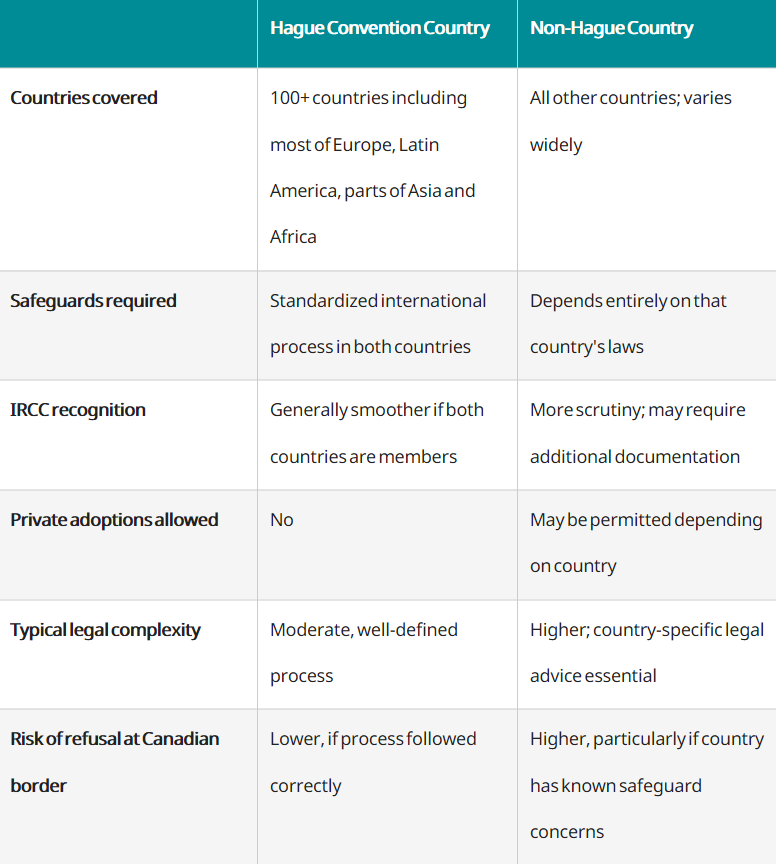
The Hague Convention prohibits private adoptions in the child's home country. The adoption must go through authorized government or agency channels in both countries. This rule protects against trafficking and fraud, but it also means that informal arrangements, even well-intentioned ones arranged through personal connections, will not be recognized under Canadian law.
Ask Journey
Is the country you are considering a Hague Convention member? If you are not sure, tell Journey the country and we will help you find out what that means for your process.
The home study: your first legal hurdle
Before any international adoption can proceed, BC requires a home study. This is a comprehensive assessment of the prospective adoptive parents conducted by a licensed BC adoption agency or social worker. It covers:
- Interviews with all members of the household
- Background checks, including criminal record searches and a prior contact check with the Ministry of Children and Family Development
- A home visit
- Medical and financial information
- References
- An assessment of your suitability to adopt, including a child description consistent with the child you are hoping to adopt
The home study is not just a BC requirement. The country you are adopting from will almost certainly require it too, and IRCC will rely on it in assessing your immigration application. A home study that is not completed by a licensed BC agency, or that does not meet the specific requirements of the country you are adopting from, will cause delays or refusals downstream.
Important
A home study approval is not permanent. If your adoption process takes longer than expected, your home study may expire and need to be updated. This happens more often than families expect, particularly when adopting from countries with longer wait times or where programs have suspended and reopened.
Country-specific legal challenges
Every country that permits international adoption has its own laws, and those laws change. Countries open and close adoption programs with relatively little notice. Families who begin a process with a particular country can find that program suspended mid-process, leaving them in legal limbo.
Some of the most significant country-specific challenges BC families have encountered in recent years:
China
China was one of the most common international adoption sources for Canadian families for decades. As of August 2024, China ended international adoption by non-Chinese nationals, with very limited exceptions for relatives and step-children of Chinese nationals. Families who had applications in progress at that point faced significant uncertainty. This is one of the starkest recent examples of how quickly a country can close its program.
Countries with suspensions or restrictions
IRCC maintains a list of countries with current adoption suspensions, restrictions, or heightened scrutiny requirements. This list changes regularly. India allows intercountry adoption under some statutes but not others. Several African countries are subject to enhanced review due to trafficking concerns. Russia has had restrictions affecting Canadian adoptions for years. Families should check current IRCC guidance before committing to a specific country program.
Non-Hague countries
Adopting from a country that has not signed the Hague Convention is possible but requires extra legal groundwork. There is no standardized process. IRCC will apply enhanced scrutiny to ensure the adoption meets the principles of the Convention, even if the country is not formally bound by it. Documentation requirements are often more extensive, translation and authentication requirements add time and cost, and the risk of IRCC refusing the immigration application is higher.
Ask Journey
Has the country you are adopting from had any recent program suspensions or changes? Journey can help you find out the current status before you go further in your planning.
The immigration and citizenship layer
Completing an adoption in another country is not enough to bring your child home. IRCC makes the final decision about whether the child can enter Canada. Families have to navigate one of two paths.
The immigration process
Under the immigration process, you sponsor the child as a permanent resident of Canada. You apply to IRCC to sponsor the child, and if approved, IRCC requests a Letter of No Objection from BC's Provincial Director of Adoption. The child must also pass a medical examination before a permanent resident visa is issued.
The Letter of No Objection will not be issued if a prospective adoptive parent has certain child welfare or criminal records. It also cannot be issued after the child has already entered Canada, so families must complete the immigration process before travelling home.
The citizenship process
If at least one adoptive parent was a Canadian citizen at the time of the adoption, and that parent can pass on citizenship by descent, families may be eligible to use the citizenship process instead. This can be faster in some circumstances. However, if the child will not live in Canada immediately after the adoption and citizenship processes are complete, the citizenship route is not available and the immigration process must be used.
Good to know
Do not plan to return to Canada with your child until you have confirmed that you meet all citizenship or immigration requirements and that the necessary visa or citizenship documentation is in hand. Families who travel before this confirmation risk being unable to re-enter Canada with their child.
Post-adoption reporting obligations
Many countries that permit international adoption require post-placement reports after the child arrives in Canada. These reports document how the child is adjusting to their new family and environment. Failing to submit them on time can affect the ability of Canadian agencies to continue facilitating adoptions from that country, which is why your agency will track these requirements closely.
BC may also require post-placement supervision and reports as part of finalizing the adoption in BC courts, particularly where the adoption was not fully completed in the child's country of origin and a BC court order is needed to confirm the adoption.
Finalizing the adoption in BC courts
Some countries issue full adoption orders that BC recognizes directly. Others issue guardianship orders rather than adoption orders, which means the adoption is not legally complete until a BC court finalizes it. This is a separate legal proceeding in BC and requires legal representation.
Even where a foreign adoption order is in place, families may want to confirm the adoption in BC courts for practical reasons: to ensure the child's legal status in BC is unambiguous, to obtain a BC birth certificate showing the adoptive parents, and to ensure the adoption is recognized in all Canadian jurisdictions.
Ask Journey
Has your adoption already been finalized in the child's home country, or is there still a BC court step outstanding? Tell Journey and we can explain what that means for your next steps.
What can go wrong, and how to protect yourself
International adoption involves real legal risk at every stage. The most common points of failure are:
- The country closes its program mid-process. This can leave families who have already paid significant fees and invested years of preparation without a clear path forward. Choosing a country with a stable program and experienced agency representation reduces but does not eliminate this risk.
- The adoption does not meet Hague Convention safeguards. IRCC can refuse an immigration or citizenship application if it finds that the adoption did not follow Hague safeguards, even if the adoption was legal in the country of origin. This is most common in non-Hague countries and where there are concerns about whether the child was legally available for adoption.
- Documentation errors or gaps. International adoption paperwork is extensive and must be precise. Errors in translation, authentication, or notarization can cause significant delays and, in some cases, refusals.
- Home study expiry. If the process takes longer than anticipated, a home study may lapse and require updating at additional time and cost.
- Relative adoptions without proper planning. Adopting a relative from abroad seems straightforward but is subject to all the same provincial, federal, and international requirements as any other intercountry adoption. Families who proceed informally can find themselves unable to bring the child into Canada.
How Pathway Legal can help
International adoption is not a process you want to navigate without experienced legal guidance. The intersection of BC adoption law, federal immigration requirements, and the laws of a foreign country creates real complexity, and mistakes at any stage can have consequences that are very difficult and expensive to undo.
At Pathway Legal, we work with BC families pursuing international adoption to understand their legal obligations, navigate the BC court process where needed, and ensure that the adoption is properly recognized under BC law. We serve clients from our offices in Victoria, Nanaimo, Vancouver, and Surrey, and by video for families anywhere in the province.
We offer a money-back guarantee on the initial consultation fee. Come in, tell us your situation, and we will give you a clear picture of where you stand and what it will take to bring your family together legally. If it is not the right fit, you do not pay.

Ask Journey
Real questions. Straight answers. No legal jargon required.
Yes! Surrogacy is legal in BC. What is not allowed is paying a surrogate a fee or wage for carrying a child. Surrogates can be reimbursed for reasonable pregnancy-related expenses. That is the altruistic model of surrogacy that BC law requires.
Not automatically, and this surprises a lot of people. In BC, the birth mother is recognized as the legal parent at birth, regardless of genetics. Intended parents need to take legal steps, usually through a Declaration of Parentage, to have their parentage officially confirmed.
The good news: BC allows pre-birth court orders and agreements, so you can have this sorted before your child even arrives.
A lot. A well-drafted surrogacy agreement covers medical decision-making during pregnancy, reimbursable expenses, what happens in the event of complications, communication expectations between the parties, and how parentage will be confirmed.
It is one of the most important legal documents you will ever sign if you are creating your family through a surrogacy arrangement.
Yes, and this is not optional. Independent legal advice for the surrogate is a foundational requirement of a sound surrogacy arrangement. Each party needs their own legal counsel to ensure the agreement is fair, informed, and enforceable.
That is exactly why the surrogacy agreement matters so much. BC law provides some protections, but it does not resolve every scenario on its own. Disputes over expenses, disagreements about medical decisions, or unexpected changes in circumstances can all arise.
A thorough agreement drafted from the start is your best protection if things do not go as planned.
This is one of the questions we hear most often, and the honest answer is . . . it is complicated. BC law gives surrogates the right to make decisions about their own bodies during pregnancy. What the law says at birth, and what recourse intended parents have, depends on the specific circumstances.
This article is for general informational purposes only and does not constitute legal advice. Family law is fact-specific and the law changes. Reading this does not create a lawyer-client relationship with Pathway Legal. For advice about your situation, consult a qualified BC family law lawyer.

Content written by:
Val Hemminger, divorce lawyer with heart, founder of Pathway Legal, terrier lover, Mom, fun person, and because every great legal team needs at least one ADHD powered person!
Not Sure Where You Stand? Talk to One of Our Lawyers
Something has shifted, and you are not sure what it means yet. That is exactly the right time to get clarity, not after you have waited too long and deadlines have passed.
Schedule a consultation with Pathway Legal.
Our initial consultation is real legal guidance, not a sales pitch. And we stand behind it: if you do not feel you received genuine value, we will refund your initial consultation fee. No questions asked.*
In the years we have done this, almost no one has asked for their money back.
*Unlike most law firms, our initial consultation is not free. Your time with one of our lawyers is real legal guidance, not a sales pitch. A one-hour conversation that helps you understand your rights, your timelines, and your options is one of the smallest investments you can make when the stakes are high.







FAX: 833-250-7771
Meeting Locations
Money-back guarantee for your initial consultation
We are SO confident you’ll be impressed with your lawyer and the support you receive at your first appointment, we’ll refund the initial consultation fee if you’re not completely satisfied.
Meeting Locations
Money-back guarantee for your initial consultation
We are SO confident you’ll be impressed with your lawyer and the support you receive at your first appointment, we’ll refund the initial consultation fee if you’re not completely satisfied.
Pathway Legal Law Corporation, Family Law Lawyers. All rights reserved Val Hemminger
Your Privacy Contact Us Legal Disclaimer SMS T&C's
Copyright © [2020] –
It is with our honour and gratitude that we live, work, and play on the traditional territory of the Coast Salish peoples–Sḵwx̱wú7mesh (Squamish), Stó:lō and Səl̓ílwətaʔ/Selilwitulh (Tsleil-Waututh) and xʷməθkʷəy̓əm (Musqueam) Nations.