

- Home
- Fertility Law in BC
- legal protection for co-parents in bc
Legal
protection for co-parents in BC
Co-parenting is built on trust and goodwill. It also needs to be built on something that holds when the trust and goodwill run thin, because those moments happen in every family.
Legal protection for co-parents in BC means having the right documents in place before things get complicated: confirmed parentage, established guardianship, and a written agreement that sets out what everyone agreed to when they were still on the same page. This article explains what each of those protections actually does, who is at risk without them, and how to close the gaps.
Why legal protection matters in co-parenting
A co-parenting agreement is a contract. Both parents sign it voluntarily, and it sets out their mutual intentions about parenting time, responsibilities, and decision-making. It does not require court involvement to create. But if one parent ignores it, the other parent has to go to court to enforce it.
A parenting order is made by a judge. It carries the full weight of a court order from the moment it is made. If one parent breaches it, the other can return to court for enforcement, and the consequences for the breaching parent are more immediate and more serious.
BC's Family Law Act allows co-parenting agreements to be filed in the court registry. Once filed, a court can treat and enforce the agreement the same way it would a court order. That single step dramatically changes what happens when someone does not follow through.
Why legal protection matters in co-parenting
Co-parents who are not in a romantic relationship do not have the same automatic legal protections that married spouses do. A co-parenting arrangement that relies entirely on trust and informal understanding leaves one or both parents exposed in ways that most families do not discover until there is a crisis.
Consider what can happen without the right protections in place:
- A non-biological co-parent cannot consent to emergency medical treatment for their own child at the hospital
- A parent whose name is not on the birth certificate has no automatic right to pick the child up from school or daycare
- If the co-parenting relationship breaks down, a parent without confirmed guardianship has no guaranteed right to parenting time
- If a parent dies without a will naming a guardian, the surviving co-parent may have to apply to court to confirm their own guardianship of the child
- A donor who was supposed to have no parental role may have legal standing if no written agreement was signed before conception
None of these outcomes are hypothetical. They are the situations that bring families to lawyers after the fact, when legal protection is harder and more expensive to establish.
The three layers of legal protection for co-parents
Solid legal protection for co-parents in BC comes from three overlapping layers. Each one matters. None of them substitutes for the others.
Layer 1: Legal parentage
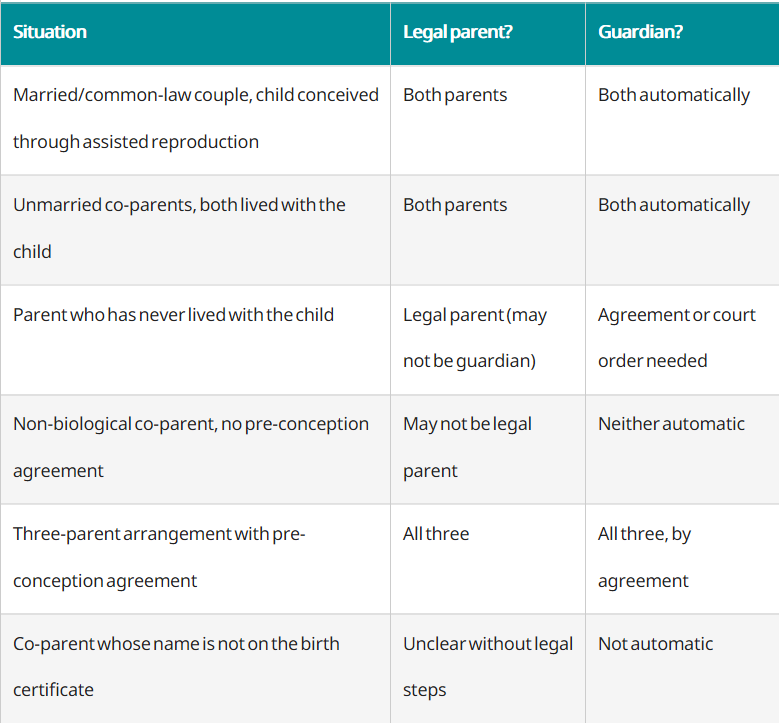
Legal parentage is the foundation. Under BC's Family Law Act, being a legal parent means your name can appear on the birth certificate, you have an obligation to financially support the child, and your relationship to the child is recognized for purposes of inheritance, citizenship, and all other laws.
Parentage is not the same as guardianship, and it is not the same as parenting time. You can be a legal parent without being a guardian, and you can be an active, involved co-parent without being a legal parent at all, though the latter leaves you without enforceable rights.
How parentage is established in a co-parenting situation depends on how the child was conceived and what agreements were in place beforehand. In BC, up to five people can be legal parents of a child conceived through assisted reproduction, provided there are pre-conception agreements in place. Most co-parenting arrangements involve two parents; some involve three.
When circumstances change: varying an agreement or order
A co-parenting arrangement that worked well when the child was an infant may not work well when they are seven. Parenting agreements and orders can be changed, but the process depends on whether you have an agreement or an order, and whether both parents agree to the change.

Good to know
A parent who has never lived with their child is not automatically a guardian under BC law, even if they are a legal parent. Parentage and guardianship are separate statuses with separate legal consequences. You may need both, and they are confirmed through different steps.
Layer 2: Guardianship
Guardianship is what gives a parent the right to make decisions for their child and the right to have parenting time. Under section 39 of the Family Law Act, a parent who has lived with the child is automatically a guardian. A parent who has never lived with the child is not, unless a written agreement or court order says otherwise.
For co-parents who live in separate households from the start, the live-with rule creates a gap. The parent who carries or births the child and lives with the child immediately is automatically a guardian. The co-parent in another home may not be, even if they are a legal parent and deeply involved in the child's life.
Closing that gap requires a written agreement between all of the child's existing guardians confirming that the co-parent is also a guardian. This is one of the most important documents a co-parenting arrangement can have, and it is one of the most commonly missed.
Important
Guardianship gives you the right to make decisions about your child's healthcare, education, and daily life, and the right to have parenting time that is enforceable if the other parent refuses. Without confirmed guardianship, you are relying on the other parent's goodwill. When that goodwill ends, so does your access.
Layer 3: A written co-parenting agreement
Even where both co-parents are legal parents and confirmed guardians, a written agreement is what translates their shared intentions into enforceable terms. The Family Law Act makes written family law agreements more difficult to set aside than informal understandings, provided they were fairly negotiated. That durability is exactly what co-parents need.
A co-parenting agreement addresses the decisions and situations that parentage and guardianship status alone cannot resolve:
- Who has parenting time, on what schedule, and how changeovers work
- How major decisions are made when the parents disagree
- How financial responsibilities are divided, including child support and extraordinary expenses
- What happens when one parent wants to relocate
- How disputes are resolved before they reach court
- What happens if one parent dies or becomes seriously ill
A well-drafted co-parenting agreement does not guarantee that nothing will ever go sideways. It guarantees that if something does, both parents have a clear record of what they agreed to, and a court has something to enforce.
Who is most at risk without legal protection
What happens when the co-parenting relationship breaks down
Most co-parenting arrangements start with mutual goodwill. When that goodwill runs out, what each parent can do depends entirely on what is written down and legally confirmed.
A co-parent with confirmed guardianship and a written agreement can apply to the BC Supreme Court or Provincial Court to enforce their parenting time, seek a parenting coordinator, or vary the agreement if there has been a material change in circumstances. A co-parent without those protections is starting from scratch in a court process, trying to establish rights they should have set up before the child was born.
The difference in time, cost, and emotional strain between those two positions is significant. Court processes for parenting disputes in BC take many months, and sometimes years, when there is nothing already in place to build on.
A written co-parenting agreement is not a sign that you expect things to go wrong. It is a sign that you take your child's stability seriously enough to protect it, even in the scenarios you are not planning for.
Steps to get legally protected as a co-parent in BC
If your co-parenting arrangement does not yet have all three layers of protection in place, here is where to start.
- Confirm parentage. If both co-parents are not yet on the birth certificate, get legal advice on how to establish parentage through birth registration, a pre-conception agreement, or a court declaration.
- Confirm guardianship. If one co-parent has never lived with the child, a written guardianship agreement signed by all existing guardians closes that gap without a court application.
- Draft a co-parenting agreement. Even where parentage and guardianship are clear, a written agreement is the document that makes the arrangement durable. Get independent legal advice before signing.
- Make a will. A will lets you name a guardian for your child in the event of your death, and ensures your co-parent is not left fighting for a role they were always meant to have.
- Review your agreement as circumstances change. Life moves. A relocation, a new relationship, a change in income, or a change in the child's needs are all reasons to revisit what you have in writing.
How Pathway Legal can help
Legal protection for co-parents is not complicated to put in place when you do it before there is a problem. It is our job to help you build the right foundation for your family so that the hard moments, if they come, do not also become legal crises.
At Pathway Legal, we work with co-parents across BC to confirm parentage, establish guardianship, draft co-parenting agreements, and when needed, bring matters before the BC Supreme Court. We serve clients from our offices in Victoria, Nanaimo, Vancouver, and Surrey, and by video for families anywhere in the province.
We offer a money-back guarantee on the initial consultation fee. If you come in and it is not the right fit, you do not pay. Our goal is to give you a clear picture of where you stand and exactly what it will take to protect your family.
This article is for general informational purposes only and does not constitute legal advice. Family law is fact-specific and the law changes. Reading this does not create a lawyer-client relationship with Pathway Legal. For advice about your situation, consult a qualified BC family law lawyer.

Content written by:
Val Hemminger, divorce lawyer with heart, founder of Pathway Legal, terrier lover, Mom, fun person, and because every great legal team needs at least one ADHD powered person
Not Sure Where You Stand? Talk to One of Our Lawyers
Something has shifted, and you are not sure what it means yet. That is exactly the right time to get clarity, not after you have waited too long and deadlines have passed.
Schedule a consultation with Pathway Legal.
Our initial consultation is real legal guidance, not a sales pitch. And we stand behind it: if you do not feel you received genuine value, we will refund your initial consultation fee. No questions asked.*
In the years we have done this, almost no one has asked for their money back.
*Unlike most law firms, our initial consultation is not free. Your time with one of our lawyers is real legal guidance, not a sales pitch. A one-hour conversation that helps you understand your rights, your timelines, and your options is one of the smallest investments you can make when the stakes are high.







FAX: 833-250-7771
Meeting Locations
Money-back guarantee for your initial consultation
We are SO confident you’ll be impressed with your lawyer and the support you receive at your first appointment, we’ll refund the initial consultation fee if you’re not completely satisfied.
Meeting Locations
Money-back guarantee for your initial consultation
We are SO confident you’ll be impressed with your lawyer and the support you receive at your first appointment, we’ll refund the initial consultation fee if you’re not completely satisfied.
Pathway Legal Law Corporation, Family Law Lawyers. All rights reserved Val Hemminger
Your Privacy Sitemap Contact Us Legal Disclaimer SMS T&C's
Copyright © [2020] –
It is with our honour and gratitude that we live, work, and play on the traditional territory of the Coast Salish peoples–Sḵwx̱wú7mesh (Squamish), Stó:lō and Səl̓ílwətaʔ/Selilwitulh (Tsleil-Waututh) and xʷməθkʷəy̓əm (Musqueam) Nations.