
- Home
- Financial Protection
- CPP Credit Splitting After Separation in BC
CPP
Credit Splitting After Separation

Canada Pension Plan credits are one of the few things in a separation that nobody owns outright, nobody can sell, and almost nobody thinks about until years later.
They are also one of the few things that can be divided long after everything else has been settled, and one of the few divisions that can never be undone.
This page explains what CPP credit splitting is, who can apply and by when, why British Columbia gives couples an option most of the country does not have, and the drafting mistake that quietly costs people the protection they thought they had.
Ask Journey, our ambassador
Journey is our beacon of hope and care, and she hears the questions families are almost too nervous to ask out loud. Here are the ones that come up most often when people are working out what happens to their CPP credits after a separation. You will find them throughout this page.
What credit splitting is
Every year you work in Canada and contribute to the Canada Pension Plan, those contributions are recorded against your name. Your eventual CPP retirement pension is calculated from that lifetime record.
Credit splitting takes the contributions both of you made during the years you lived together, pools them, and divides them equally. The formal name is a division of unadjusted pensionable earnings, which Service Canada shortens to a DUPE.
The effect is straightforward. The person who contributed more usually sees their future CPP go down. The person who contributed less sees theirs go up. It applies regardless of who earned what, and it applies even if one of you never contributed at all.
Once it is done, it is done
An approved credit split is permanent. It cannot be reversed by agreement, by a later court order, or by remarriage. This is one of the few decisions in a separation with no route back, which is why it is worth understanding before anyone applies.
ASK JOURNEY
Our separation agreement divided everything. Does it handle the CPP automatically?
No, and this is the most common misunderstanding we see. A separation agreement does not divide CPP credits. Someone has to apply to Service Canada, and until that happens nothing moves.
Either of you can make the application. It does not require the other person's consent or cooperation, and it does not require a court order.
If your agreement says the credits will be split, treat that as a task on someone's list rather than something that has already happened.
Who can apply, and by when
The rules depend on whether you were married, whether you divorced, and when the relationship ended.
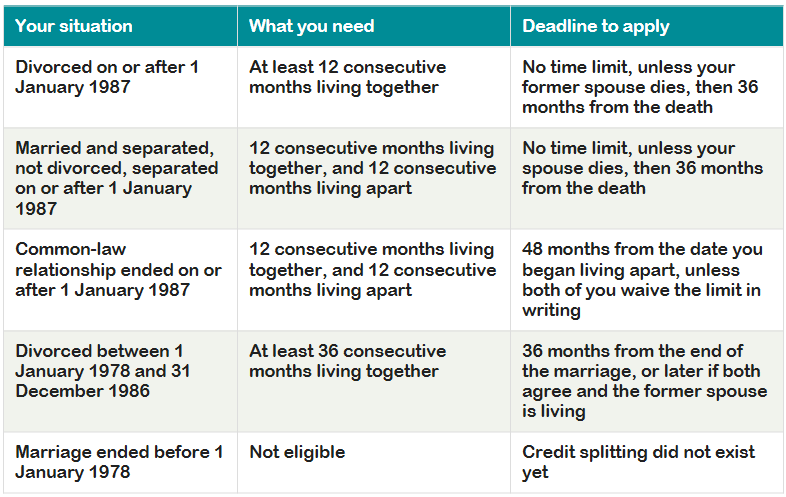
The common-law deadline is the one that bites
Four years from separation sounds generous until you are living it. Former common-law partners lose this claim more often than any other group, and the only rescue afterward is a written waiver from the person on the other side, who by then may have no reason to sign one.
ASK JOURNEY
We divorced eleven years ago and never dealt with CPP. Have I missed it?
Probably not. For married spouses who divorced on or after 1 January 1987, there is no time limit on applying.
The exception that closes the door is death. If your former spouse has died, the window is 36 months from the date of death.
Given that, this is worth doing rather than leaving on the list. Eleven years of intending to get to it is how people end up outside the only deadline that exists.
What gets counted, and what does not
The split covers the years you lived together, beginning with the year you started and running to the end of the year before you separated. Some periods are left out of the calculation entirely:
- Any period before either of you turned 18.
- Any period after either of you turned 70.
- Any period when one of you was receiving a CPP or Quebec Pension Plan retirement pension.
- Any period when one of you was considered disabled for CPP or QPP disability purposes.
- Any year where your combined pensionable earnings were no more than twice the year's basic exemption
Old Age Security is not divisible at all. It is based on age and years of residence in Canada rather than on contributions, so it never forms part of this.
ASK JOURNEY
I was the higher earner for our whole marriage. How much will this cost me?
It depends on the gap between your contribution records and how many years you were together, and it is knowable rather than a mystery. Service Canada can provide an estimate before anyone commits.
Where both of you contributed at similar levels, the effect is often small. Where one of you was out of the workforce for years, it can be substantial in both directions.
Get the estimate before you negotiate around it. We see people trade away real money to avoid a split that would have cost them very little, and the reverse.
British Columbia gives you a choice most provinces do not
Credit splitting is federal law, and federal law makes it mandatory unless a province has passed legislation permitting spouses to agree otherwise. Four provinces have: British Columbia, Alberta, Saskatchewan, and Quebec.
In Ontario and most of the rest of the country, a clause saying the credits will not be split has no effect. Service Canada will divide them anyway if either person applies.
In BC, spouses can agree not to divide their CPP credits, and that agreement binds the Minister. It is a real bargaining chip, and it is one that lawyers from other provinces sometimes do not know exists here.
The clause that works, and the clause that fails
Opting out is not a matter of saying so in general terms. Section 55.2(3) of the Canada Pension Plan sets out what the provision has to do, and every requirement has to be met:
- The agreement is in writing and was entered into on or after 4 June 1986.
- The provision expressly mentions the Canada Pension Plan by name.
- It indicates the intention of both people that there be no division of unadjusted pensionable earnings.
- That kind of provision is permitted by the provincial law governing the agreement, which in BC it is.
- The agreement was entered into before the application for the division was made.
- The provision has not been invalidated by a court order.
Generic wording does not work
A clause saying that CPP and Old Age Security benefits are each party's own individual property has been found not to meet the test. It does not mention the Act in the required way and it does not state the intention that there be no division. The credits were split despite the agreement. Wording that sounds like it covers CPP is not the same as wording that satisfies the section.
ASK JOURNEY
Our agreement says our pensions and benefits are each our own property. Are we covered?
Very possibly not. That wording is close to language a tribunal has already found insufficient, and the consequence is that the credits get divided anyway.
The provision needs to name the Canada Pension Plan and state that the two of you intend there to be no division of unadjusted pensionable earnings. Anything softer is a risk.
If you have an agreement with general wording and the opt-out matters to you, have it reviewed. Where neither of you has applied yet, an amendment may still be possible.
When opting out makes sense, and when it does not
The instinct of a higher earner is to opt out, and the instinct of a lower earner is to insist on the split. Both instincts are sometimes wrong.
There is a feature of CPP that makes this genuinely counterintuitive. The child rearing provision already protects a parent who left the workforce to raise young children by setting aside those low-earning years in the calculation. Where that protection is already doing its work, a credit split can produce an outcome where the higher earner loses more than the lower earner gains.
The value disappears rather than moving across. Nobody receives it.
Run the numbers before you decide
This is a question for an estimate and a financial advisor, not for a principle. A split that looks obviously fair can leave both people worse off, and a split that looks obviously unfair can be the right outcome. The numbers are available, and they settle the argument quickly.
ASK JOURNEY
My ex wants me to waive the credit split. Should I?
Not without knowing what you are waiving. The starting point is an estimate from Service Canada showing what the split would do to each of your future benefits.
If you do give it up, it is reasonable to receive something in exchange, and that trade should reflect a real valuation rather than a guess.
There are situations where waiving costs you almost nothing and buys you something you want. There are others where it quietly removes a meaningful part of your retirement income. The estimate tells you which one you are in.
Credit splitting is not pension sharing
These two are constantly confused, including in professional correspondence.
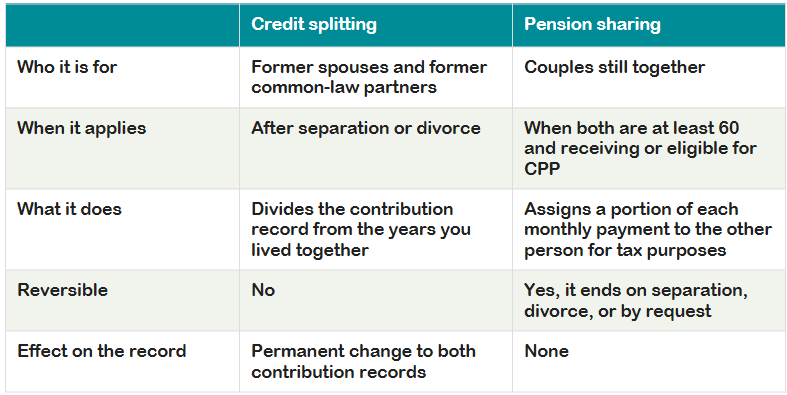
If you separate while pension sharing is in place, it stops. Credit splitting then becomes the relevant question, and it is a different application.
The timing trap
The opt-out provision has to be in the agreement before an application for the division is made. That ordering matters more than people expect.
Either former spouse can apply on their own at any point, without telling the other. Where one person applies while the agreement is still being negotiated, the opportunity to opt out can be gone before the ink is dry.
If CPP credits are a live issue in your negotiation, deal with them early rather than leaving them as a tidy-up clause at the end.
ASK JOURNEY
My ex has already applied. Can I stop it or undo it?
Stopping it is unlikely and worth asking about immediately, because the answer depends on where the application sits in the process.
Undoing an approved split is not available. Once it is granted, it is permanent, and a later agreement between the two of you will not reverse it.
What remains open is the rest of the negotiation. If the split has changed the retirement picture for one of you, that is relevant to spousal support and to how other property is divided.
How to apply
The application goes to Service Canada, not to a court and not to a pension plan. You will generally need:
- The application form for a division of unadjusted pensionable earnings.
- Social insurance numbers for both of you.
- The dates you began living together and the date you separated.
- A marriage certificate, and a divorce order or decree absolute where there was one.
- Supporting documents showing the cohabitation dates where the relationship was common-law.
Service Canada notifies the other person, who has an opportunity to dispute the dates. Getting the cohabitation and separation dates right at the outset avoids most of the delay.
ASK JOURNEY
Do I need a lawyer to apply, or can I do it myself?
The application itself is an administrative form, and many people complete it without a lawyer.
Where advice earns its keep is the decision underneath it: whether to apply, whether to opt out, what a waiver is worth, and how any of it interacts with spousal support.
If you are already working with us on a separation agreement, the CPP question belongs inside that conversation rather than as a separate errand afterward.
Where this fits in your separation
CPP credits sit alongside workplace pensions, RRSPs, and the family home as part of the retirement picture, and they are the piece most often left out of the conversation. A retirement plan built on the assumption that a credit split will happen, or will not happen, is only as good as the paperwork underneath it.
- Decide the CPP question during the negotiation, not afterward.
- Get an estimate before trading the credit split against anything else.
- If you are opting out, use wording that satisfies the federal test rather than general language about benefits.
- If you are splitting, put the application on someone's list with a date attached.
- Check the deadline that applies to you, especially if you were common-law.
How we work with you
Our approach follows the P.A.T.H. Method.
- Practical. We tell you what a credit split does to your retirement income in numbers, not principles.
- Action-Oriented. We deal with CPP while the separation agreement is being built, because the opt-out window can close without warning.
- Trustworthy. We say when a waiver is a poor trade for you, including when it is the one you proposed.
- Heart-Centred. Decades of a shared working life sit behind this record, and we never lose sight of that.
Court is the last resort. Negotiation, mediation, and collaborative practice come first, and the great majority of the separations we work on reach a final separation agreement without a judge deciding anything. We recommend clients bring their lawyers to mediation.
We help families across British Columbia reach final separation agreements that deal properly with pensions and CPP, from our offices in Victoria, Nanaimo, Vancouver, and Surrey, and by video anywhere in the province. Journey, our beacon of hope and care, is part of how we remind families that they are not walking this road alone.
This article is for general informational purposes only and does not constitute legal advice. Family law is fact-specific and the law changes. Reading this does not create a lawyer-client relationship with Pathway Legal. For advice about your situation, consult a qualified BC family law lawyer.

Content written by:
Val Hemminger, divorce lawyer with heart, founder of Pathway Legal, terrier lover, Mom, fun person, and because every great legal team needs at least one ADHD powered person
Not Sure Where You Stand? Talk to One of Our Lawyers
Something has shifted, and you are not sure what it means yet. That is exactly the right time to get clarity, not after you have waited too long and deadlines have passed.
Schedule a consultation with Pathway Legal.
Our initial consultation is real legal guidance, not a sales pitch. And we stand behind it: if you do not feel you received genuine value, we will refund your initial consultation fee. No questions asked.*
In the years we have done this, almost no one has asked for their money back.
*Unlike most law firms, our initial consultation is not free. Your time with one of our lawyers is real legal guidance, not a sales pitch. A one-hour conversation that helps you understand your rights, your timelines, and your options is one of the smallest investments you can make when the stakes are high.







FAX: 833-250-7771
Meeting Locations
Money-back guarantee for your initial consultation
We are SO confident you’ll be impressed with your lawyer and the support you receive at your first appointment, we’ll refund the initial consultation fee if you’re not completely satisfied.
Meeting Locations
Money-back guarantee for your initial consultation
We are SO confident you’ll be impressed with your lawyer and the support you receive at your first appointment, we’ll refund the initial consultation fee if you’re not completely satisfied.
Pathway Legal Law Corporation, Family Law Lawyers. All rights reserved Val Hemminger
Your Privacy Sitemap Contact Us Legal Disclaimer SMS T&C's
Copyright © [2020] –
It is with our honour and gratitude that we live, work, and play on the traditional territory of the Coast Salish peoples–Sḵwx̱wú7mesh (Squamish), Stó:lō and Səl̓ílwətaʔ/Selilwitulh (Tsleil-Waututh) and xʷməθkʷəy̓əm (Musqueam) Nations.