
- Home
- Separation in BC
- Dividing Pensions in a BC Separation
Dividing
Pensions in a BC Separation
For couples who separate after decades together, the pension is often the single largest thing they own. It routinely outvalues the house, and it tends to be the asset people understand least.
It is also the one where a decision made quickly, or made without the numbers, can quietly shape the next thirty years of someone's life.
This page explains how pensions are divided in British Columbia, what changes once a pension is already being paid, how survivor benefits work, and the deadlines that close doors.
Ask Journey, our ambassador
Journey is our beacon of hope and care, and she hears the questions families are almost too nervous to ask out loud.
Why
the pension carries more weight in a later-life separation
In a separation at 35, a pension is a distant abstraction and both people have working decades ahead to recover. At 58, the picture is different in every direction.
- The pension may represent thirty years of contributions and be worth several hundred thousand dollars or more.
- There is far less time to rebuild retirement savings from earnings at 58 years old compared to 28 years old.
- One spouse may have stepped back from paid work for years to raise children or support the other's career, and holds little or no pension of their own.
- Retirement may be close enough that decisions made now take effect almost immediately.
- Health, longevity, and the cost of care are real considerations rather than theoretical ones.
None of that changes the law. It changes what is at stake when the law is applied carelessly.
ASK JOURNEY
I stayed home with our children for twelve years. Does that count for anything?
It counts a great deal, and not in the way everyone expects. dBC does not divide family property based on who earned it, so you do not need to show a contribution to the pension to share in it.
The pension earned during your relationship is family property, and the starting point is an equal division of the portion built up while you were together.
Those years may also matter to spousal support, which is a separate question from property division and often the more significant one where careers diverged.
Pensions
are family property in BC
Part 6 of the Family Law Act governs how pensions are divided in British Columbia, and it applies to a wider group than many people assume.
- Married spouses.
- People who lived together in a marriage-like relationship for at least two continuous years.
For property and pension division, the two-year threshold is what matters. The separate route into spousal status through having a child together does not extend to property or pension division.
The portion of the pension built up during the relationship is family property. The starting point is that it is divided equally, and the division happens inside the pension plan rather than through one spouse writing the other a cheque.
You do not need a court order
A written separation agreement is enough to divide a pension in BC, provided it says the right things and the correct form goes to the plan administrator. Most pension divisions we handle never involve a judge.
ASK JOURNEY
We were common-law for nineteen years and never married. Do I have a claim to his pension?
Yes. Two continuous years in a marriage-like relationship makes you a spouse for property and pension division under the Family Law Act, and nineteen years is well past that.
This surprises people in both directions every week. The absence of a marriage certificate does not remove the claim.
There is one caution that applies more sharply to unmarried spouses, and it is a deadline. It is covered further down this page.
Three
kinds of pension, three different processes
How a pension gets divided depends almost entirely on what kind it is and whether payments have started. This is the single most useful thing to work out early.
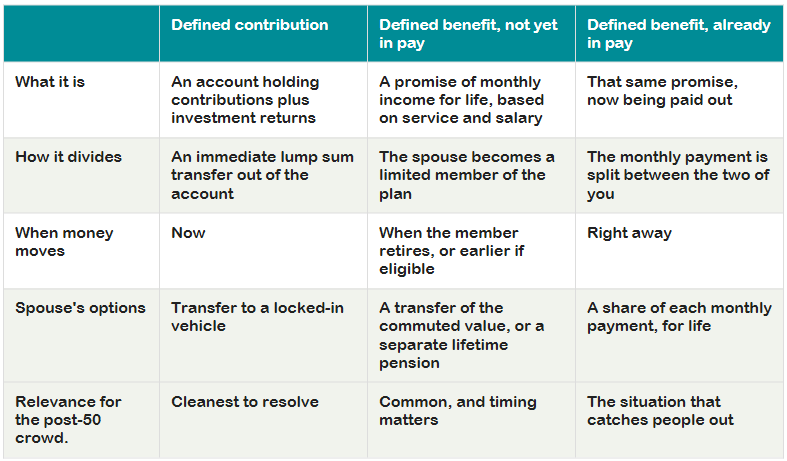
Defined benefit plans are common in the public sector, including teachers, nurses, municipal employees, and the public service. Defined contribution plans are more common in the private sector. Some people hold both, and some hold a hybrid.
ASK JOURNEY
How do I find out which kind my spouse has, and what it is worth?
Start with a request for information sent to the plan administrator. It tells the plan there is a separation and asks for the details, and it protects your position while things are being worked out.
The administrator can provide a statement of the member's benefits. For a defined benefit plan, you may also want an independent valuation, because the plan statement and the true value to a family law division are not always the same number.
Do this early. Gathering pension information is slow, and it is the step that most often holds up a final separation agreement.
How
much of the pension gets shared
Not all of it. Only the part built up during the relationship, which the legislation calls the entitlement period.
The longer you were together, the more the pension is shared.
For a defined benefit pension, BC uses a formula rather than a negotiation. In simple terms, the spouse's proportionate share is half of the pensionable service accumulated during the relationship, divided by total pensionable service. A plan administrator applies it, so the arithmetic is not something the two of you have to fight about.
For a defined contribution account, the share is half of the contributions made during the relationship, plus the growth on them.

You can agree to something different
The formula is the default, not a ceiling or a floor. Spouses can agree to a different division, including trading the pension against other property, provided the agreement is properly drafted and both of you have independent legal advice. What you cannot do is leave the member with less than half of their own benefits.
ASK JOURNEY
He had that pension for fifteen years before we met. Am I sharing in all of it?
No. The years before your relationship began are outside the entitlement period and stay with him.
The formula handles this automatically by comparing service during the relationship against his total service, so a long pre-relationship career reduces your share without anyone having to argue about it.
The dates that define the entitlement period matter a great deal. Getting the separation date right is worth doing carefully, because it sets the end point.
When
the pension is already being paid
This is the situation that defines a later-life separation, and it is where the options narrow.
Once a defined benefit pension has commenced, the flexible choices are gone. There is no lump sum to transfer and no separate pension to create. What remains is dividing the income stream.
The spouse becomes a limited member of the plan. The administrator splits each monthly payment, withholds tax separately for each of you, and pays you each directly. The limited member receives that share until they die or the pension ends.
This is why timing is not neutral
A pension that has not yet commenced can be divided in several ways. The same pension, once in pay, can only be divided as an income stream. If retirement is approaching while you are negotiating, that is a reason to get advice sooner rather than letting the matter drift.
ASK JOURNEY
He is already retired. Can I take a lump sum instead of a monthly share?
Not from the plan. Once a defined benefit pension is in pay, dividing the income stream is the mechanism available, and the plan will not convert your share into a lump sum.
There can still be a way to get a similar result. The two of you can agree that he keeps the whole pension and you receive more of something else, such as the home or investments, to reflect its value. That requires a proper valuation so you are trading like for like.
Whether that trade is a good idea depends on your age, your health, your other income, and the tax treatment on both sides. It is worth modelling before you agree to it.
Survivor
benefits, the part people often miss
Survivor benefits are what a pension pays out after the member dies, and they are handled separately from the division of the pension itself. This is the detail that most often gets left out of an agreement.
In BC, a plan member with a spouse is generally required to take a form of pension that pays a survivor benefit to that spouse. Once a pension has commenced in a joint and survivor form, the survivor benefits belong to the spouse, and they cannot simply be reassigned to a new partner later.
Put it in the agreement
Whatever the two of you decide about survivor benefits, say so expressly in the separation agreement. Silence is not neutral here. It leaves a question that surfaces at the worst possible moment, after someone has died.
ASK JOURNEY
My ex has remarried. Does his new wife get the survivor benefit instead of me?
Often not, and the answer turns on the specifics of the plan and what was elected when the pension commenced.
Where the pension commenced in a joint and survivor form naming you, those benefits are generally yours, and a later marriage does not move them. Federal plans work differently, and a divorced former spouse can lose survivor entitlement entirely under some of them.
This is worth a direct answer for your plan rather than a general one. Ask before you assume in either direction, because both spouses tend to guess wrong about this one.
CPP
credits are a separate system
Canada Pension Plan credits are divided under federal rules, not under the Family Law Act, and nothing in your separation agreement divides them automatically. Someone has to apply to Service Canada.
Credit splitting pools the CPP contributions you each made during the years you lived together and divides them equally. One person's future CPP goes up and the other's goes down. Once approved, it is permanent.
British Columbia is one of a small number of provinces where spouses can agree not to split CPP credits. In most of the country that agreement would not hold. That makes it a live negotiating point here, and a clause worth getting right.
Old Age Security is not divisible. It is based on age and residency in Canada rather than on contributions, so it does not form part of the division.
You can learn more about splitting your CPP Credits in this article: CPP Credit Splitting after Separation
ASK JOURNEY
I earned far more than my spouse. Will credit splitting reduce my CPP?
It can, yes. Credit splitting equalizes the contributions from the years you lived together, so the higher earner's future benefit usually goes down and the lower earner's goes up.
In BC you can agree not to split, which is unusual in Canada and gives you something real to negotiate with.
Before you trade it away or insist on it, get an estimate of the actual dollar effect on both sides. It is often smaller than people fear, and occasionally much larger.
Federal
pensions follow different rules
If the pension is with the RCMP, the Canadian Armed Forces, or the federal public service, Part 6 of the Family Law Act does not govern the division. The federal Pension Benefits Division Act does.
The practical differences matter:
- Division is usually a one-time lump sum transfer rather than an ongoing monthly share.
- An application is generally made after the parties are divorced or have been separated for at least one year.
- The maximum transferable is half of the value of the benefits accumulated during the relationship.
- Survivor benefit rules differ, and a divorced former spouse may lose entitlement altogether.
- Different forms and a different administrator are involved.
If a federal plan is in the picture, say so at the first meeting. The strategy and the paperwork diverge from the provincial route early.
The deadlines that close doors
Pension claims live inside limitation periods, and they run quietly.
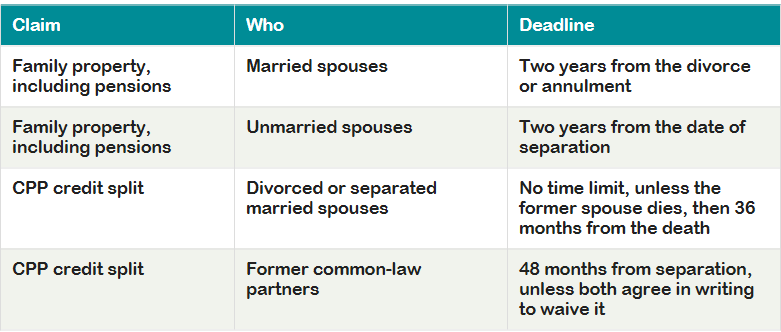
The Family Law Act clock pauses while you are engaged in family dispute resolution with a qualified professional, which is one more reason to start mediation earlier rather than later.
Unmarried spouses face the tightest window
Two years from the date of separation passes quickly when you are grieving a long relationship. If you were common-law and you have been putting this off, the pension claim is the one most likely to be lost to delay.
ASK JOURNEY
We separated two and a half years ago and never sorted out the pension. Is it gone?
Not necessarily, and this needs advice quickly rather than eventually. Whether the clock has run depends on whether you were married, when it started, and whether anything paused it.
There are situations where time has not run out, including where you were married and never divorced, and where family dispute resolution was underway.
Bring the dates to a first meeting: when you began living together, when you separated, and whether there was a divorce. A lawyer can tell you where you stand in one conversation.
Trading the pension for the house
This comes up in nearly every later-life separation. One spouse wants to stay in the home, the other keeps the pension, and everyone feels the fairness of it immediately.
It can be a good arrangement. It can also be the most expensive decision either person makes, and the reasons are not obvious.
- A dollar of pension and a dollar of home equity are not the same dollar. Pension income is taxed when it is received, while the sale of a principal residence generally is not.
- A defined benefit pension often carries inflation protection and pays for life. A house does not pay anything, and it costs money to hold.
- A house is illiquid. A person with a paid-off home and little income can struggle month to month.
- Keeping a family home into a single-income retirement can mean carrying maintenance, taxes, and insurance on one pension rather than two.
This is where a valuator and an accountant earn their fees. We work alongside them so that the trade is measured on an after-tax basis, rather than on two numbers that look equal on paper.
ASK JOURNEY
I want to keep the house. It is where our children grew up.
That matters, and it is a reasonable thing to want. We would never treat it as sentiment to be talked out of.
What we would ask is that you see the numbers first: what the house costs you each year, what income you will have, and what you are giving up on the other side of the trade.
Some people look at the numbers and keep the house anyway, with their eyes open. Others discover that what they wanted was security rather than that particular building. Both are good outcomes, and both beat finding out at 70.
What the process looks like
Pension division is procedural rather than adversarial. The usual sequence:
- Identify every pension on both sides, including old employment neither of you has thought about in years.
- Send Form P1 to each plan administrator to request information and register the claim.
- Obtain statements, and a valuation where the numbers warrant one.
- Decide how the pension is being divided, whether by the formula or by a negotiated trade.
- Put it in a written separation agreement, with independent legal advice on both sides, expressly providing that Part 6 applies and dealing with survivor benefits.
- Send the agreement to the administrator with the correct form, P2, P3, or P4 depending on the plan and its stage.
- Deal with CPP credit splitting separately, through Service Canada.
Most of this happens through correspondence. You have heard us say this before, court should be a last resort, and a contested property matter can run many months, and sometimes years, which is rarely a good use of a retirement that is already underway if you are at that age?
ASK JOURNEY
What is the one thing I should do first?
Find out what pensions exist and what stage each one is at. Everything else follows from that, and it is the piece that takes longest to gather.
If you know a pension is close to commencing, move faster. The options available before a pension starts are wider than the options after.
Bring whatever you have to a first meeting, even if it is incomplete. A partial statement and a set of dates is usually enough for a clear picture of where you stand.
How we work with you
- Practical. We tell you what the pension is worth and what the division means for your monthly income, in numbers rather than principles.
- Action-Oriented. We send the forms and chase the administrators, because delay in a pension matter costs real money.
- Trustworthy. We say when a proposed trade is a poor one for you, including when it is the one you asked for.
- Heart-Centred. Forty years of a shared life sits behind these numbers, and we never lose sight of that.
A note on how Pathway Legal works
We are a client-focused resolution-first law firm. That means we believe going to court is almost always the last resort, not the first move. Court takes many months, and sometimes years. It costs more than most families expect. And it rarely gets anyone to a better outcome than good negotiation would have.
We will always tell you the truth about your options. We will not push you toward a process that serves our billables over your family. And if we think you need something we can not provide, we will tell you that too.
That is what Pathway means to us: a way through this that actually leads somewhere worth going.
This article is for general informational purposes only and does not constitute legal advice. Family law is fact-specific and the law changes. Reading this does not create a lawyer-client relationship with Pathway Legal. For advice about your situation, consult a qualified BC family law lawyer.

Content written by:
Val Hemminger, divorce lawyer with heart, founder of Pathway Legal, terrier lover, Mom, fun person, and because every great legal team needs at least one ADHD powered person
Not Sure Where You Stand? Talk to One of Our Lawyers
Something has shifted, and you are not sure what it means yet. That is exactly the right time to get clarity, not after you have waited too long and deadlines have passed.
Schedule a consultation with Pathway Legal.
Our initial consultation is real legal guidance, not a sales pitch. And we stand behind it: if you do not feel you received genuine value, we will refund your initial consultation fee. No questions asked.*
In the years we have done this, almost no one has asked for their money back.
*Unlike most law firms, our initial consultation is not free. Your time with one of our lawyers is real legal guidance, not a sales pitch. A one-hour conversation that helps you understand your rights, your timelines, and your options is one of the smallest investments you can make when the stakes are high.







FAX: 833-250-7771
Meeting Locations
Money-back guarantee for your initial consultation
We are SO confident you’ll be impressed with your lawyer and the support you receive at your first appointment, we’ll refund the initial consultation fee if you’re not completely satisfied.
Meeting Locations
Money-back guarantee for your initial consultation
We are SO confident you’ll be impressed with your lawyer and the support you receive at your first appointment, we’ll refund the initial consultation fee if you’re not completely satisfied.
Pathway Legal Law Corporation, Family Law Lawyers. All rights reserved Val Hemminger
Your Privacy Sitemap Contact Us Legal Disclaimer SMS T&C's
Copyright © [2020] –
It is with our honour and gratitude that we live, work, and play on the traditional territory of the Coast Salish peoples–Sḵwx̱wú7mesh (Squamish), Stó:lō and Səl̓ílwətaʔ/Selilwitulh (Tsleil-Waututh) and xʷməθkʷəy̓əm (Musqueam) Nations.